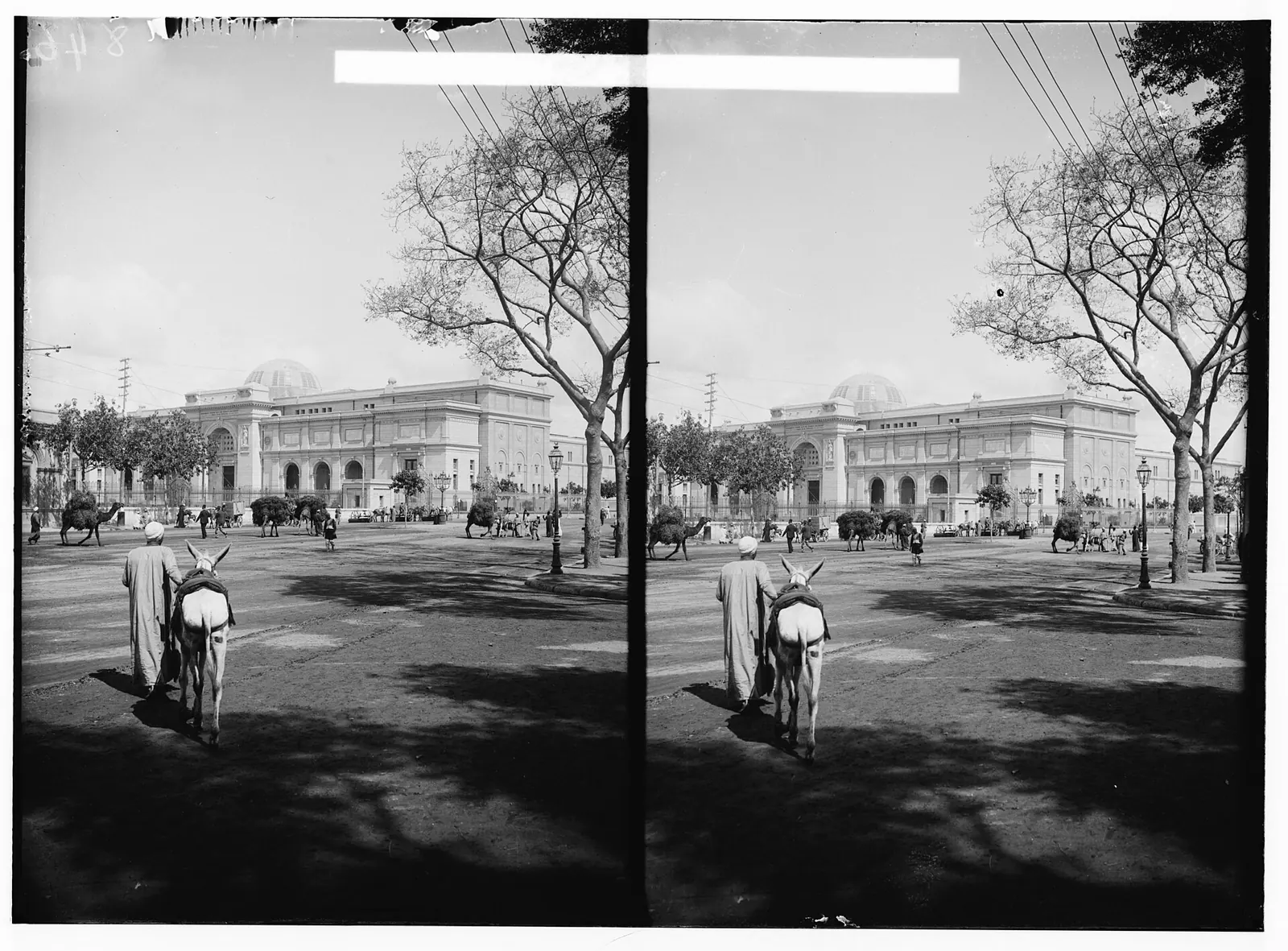
Choose Tahrir when you enjoy comparing many objects in a historic display environment. Its abundance is intellectually productive, but it requires stronger self-navigation than newer museums.
WHY CHOOSE IT
Choose the museum as well as the objects.
The 1902 building, tall cases and long sightlines preserve layers of museum history. Here, display density enables comparison: several examples of a form may sit close enough to expose variation. Visitors interested in how archaeology was classified and shown will find the environment as revealing as individual works.
If you need sparse labels, predictable circulation or low visual stimulation, Luxor Museum or a tightly selected route elsewhere may be a better fit.
A REALISTIC ROUTE
Create four anchors.
Identify the main hall, stairs and exit first. Then choose four anchors: one monumental sculpture; one small everyday object; two neighbouring works to compare; and one object you did not expect. Return to the central volume between them whenever orientation slips.
Do not rely on an old highlights list. Transfers and redisplay have changed collection locations, and a famous object associated with Tahrir may now be elsewhere.
WHAT IT EXPLAINS BEST
Typology, variation and museum history.
Dense groupings make it possible to compare posture, vessel form, coffin decoration, script or material across examples. Ask why objects share a case: date, site, function, collector or older curatorial convention?
Inventory numbers are particularly valuable. They remain stable identifiers when gallery arrangements and common object names change.
PRACTICAL LIMITS
Historic architecture needs advance questions.
Ask specifically about lifts, step-free circulation, accessible facilities, seating and active floors. Central Cairo traffic and pedestrian approaches add variability. Build in a buffer and avoid planning a timed cross-city transfer immediately afterward.
Verify before travel
Confirm current galleries, object locations, camera and bag rules, opening period and accessible route with the museum. This profile intentionally avoids ticket prices and temporary displays.